Warner Brothers had built a dirt road to a dark laurel thicket by the river. It was a rough, steep track that got slicker and more dangerous every afternoon when rain poured from the skies. The trees were enormous, forming a thick canopy hundreds of feet in the air. It was a rain forest, right here in the mountains of Georgia. Its floor was so shadowed that small plants found it impossible to grow in the thick loam of the rotting leaves. The mountain laurel was not shrubbery but a collection of trees twisted like gnarled fingers reaching for the light. The whole effect was beautiful and threatening. This was where the rape scene was going to be filmed.
The script called it “Resting Place.” It is the second day of the story. Ed and Bobby in one canoe have gotten separated from Lewis and Drew in the other and they pull over to the side of the river to wait for them to catch up. Coming at them out of this dark forest they see two mountain men, one of them carrying a double-barreled shotgun.
One of the mountain men, the smarter of the two, was played by Bill McKinney, a serious character actor whose main obsession off the set seemed to be looking after his body. Each morning he swallowed dozens of vitamin and mineral pills, and when he talked to you he’d study with casual fascination the veins and sinews standing out on his own forearms. Burt claimed he saw him running naked through the Kingwood golf course in the early mornings.The other was Herbert “Cowboy” Coward, who had worked with Burt a few years before at one of those Wild West shoot-out shows in a rickety amusement park in the Smoky Mountains. Cowboy was no actor, but the script called for the character to be missing his front teeth, and Cowboy looked like his had been knocked out with a ball peen hammer. The character had to seem at once terribly stupid and terribly frightening. Cowboy could do that. He never left character. But when he talked, he usually stuttered, and when he tried not to stutter, words would come out in weird orders. “You ain’t a’goin any damn wheres,” was a line that stayed in the movie. “I’m g-g-gonna lay a b-b-big long dick right in your mouth,” was one that didn’t.

For the first few days at “Resting Place” there was a full crew on the set. There were some problems with new lights that the cinematographer brought in. The preparations were slow, conditions uncomfortable. A lot of people were getting sick in the constant damp and changing temperatures. A couple of the gaffers who’d been working in the water day after day were getting lesions like jungle rot. Others were busy spreading calamine lotion on poison ivy, chigger infestations, mosquito bites. At first there were a lot of jokes about snakes, but there were a lot around, and soon they were taken seriously. We’d see cottonmouths in the water and big rattlers sunning themselves on the higher, drier stretches of the road. One day as I was walking with the hair stylist from the set to the riverside mess tent for lunch, talking about the tensions that were growing around the scene that was coming, and not really thinking about where we were putting our feet, I saw a shape in the middle of the path just in front of us. It was fatally still. Its back was patterned like leaves. “Freeze,” I said, and touched the hair stylist’s shoulder. Her foot stopped in mid-air, inches above the copperhead. The snake’s sullen, slow-moving skull lay like an arrowhead in the black compost, its body thick and passive. One of the lighting men decapitated it with a shovel and skinned it. We knew there were others around, waiting.

The leads rehearsed, memorized lines, or practiced canoeing. All of them were getting pretty good at it, and out on the river, most of the day anyway, at least there was sun. But at Resting Place the mood was getting darker. Ned Beatty no longer played the happy fat boy around the set. He was getting harder to talk to, brooding, concentrating. The day of the shooting, Burt and Ronny weren’t called. The press, even the studio’s photographer, was barred from the set. The hair stylist and the nurse were asked to go watch the river.
There is a full rehearsal which tells us what’s to come. One of Boorman’s great talents is the way he orchestrates the movement of his actors through the frame, and the movement of the camera around his actors. His cinematographer, Vilmosz Szigmund, sets up a master shot in which the actors go through the entire scene, and the camera takes it all in. Ed is pushed up against a tree and strapped there by the neck with his own web belt. McKinney takes a big hunting knife Ed carries and asks him how he’d like his balls cut off, then cuts a line across Ed’s chest just to watch him bleed. Bobby is standing at a distance. McKinney tells him to drop his pants. Cowboy points the shotgun at him and gives a big grin that is no less horrifying for being so ludicrous, so hungry. When he’s stripped to his jockey shorts, Bobby panics and tries to run. McKinney chases him, Bobby is trying to scramble up a steep hillside on all fours but the earth and leaves slip away beneath him. McKinney grabs him, pushes him up the bank for a few feet, then follows him, pawing him, squeezing Bobby’s ass and his breasts, sliding and falling back down into the rotting leaves. He grabs Bobby by the ear and the nose like a pig and half drags him, half rides him to a decaying log, forces him to lie over it, and rapes him.

One of the assistant directors called me from the sidelines and had me follow the actors through the scene. I was going to stand in for Ned while they set up the lights and the track for the camera. I didn’t have to take off my clothes. All I had to do was go through the general motions, standing on the marks set up during the rehearsal, crawling as if in slow motion up the steep bank covered with leaves. No one led me by the nose, or rode me like a sow. But I had to lie down over the log, with the wood pressing into my stomach, and there were no jokes that could be made, there was nothing for anyone to say, that could keep me from feeling humiliated. I couldn’t wait for this day to be over. But it was only beginning.
Jon and Ned, McKinney and Cowboy come back onto the set. They’ve been looking for a way to match dialogue to action and somebody has the idea of making Ned squeal as McKinney forces him over the log. “Squeal like a pig…. Squeeeeal! ….. Squeeeeal!” And Ned does, in terror at first, and then, slowly, horribly, the squeals become groans of pain. And finally Boorman calls, “Cut.” Then the action is run again, and again, each time growing more grotesque. At lunch there were several nervous, risqué jokes. There was some kidding about McKinney getting carried away. Ned tried to snap back out of character, to relax. But it wasn’t working. And that day, and for the rest of the time he was in north Georgia, he seemed to have changed, as if whatever sadness or insecurity he’d covered up before as a man, as Ned Beatty, just couldn’t be contained any more.

In the afternoon there were more shots of the same scene, but now from different angles. I wanted to go somewhere else, but I had to stay available to stand in, or lie down, or kneel for every new camera set-up. I didn’t watch the shooting anymore, but I couldn’t get away from the sound. That night I called my father. I was sick of the film, sick of the whole story. And I wondered why the hell he had to have this homosexual rape. “I had to put the moral weight of murder on the suburbanites,” was what my father told me. It was what he always said. He had to portray the mountain men as such monsters that the suburbanites would decide not only to kill, but to try to cover up their crime. Lewis can shoot McKinney in the back with an arrow, and look around at this forest about to be inundated by a dam, and say “Law? What law?” and every man watching will think, yeah, bury the son of a bitch.
I understood that was the way it was supposed to work. But I didn’t think my father understood what had happened that day filming by the river. In the book you can read the rape scene and know it happened, but you get around it and go on, and get other things out of the novel. In the movie – it was becoming what the movie was about. It was the thing everybody was going to remember. “Squeal like a pig!” Not Lewis’s survivalism, not the climb up the cliff, not Ed’s conquest of his own fear. It was all going to be about butt-fucking. “You’re wrong, son,” my father said.
There was something else that I wanted to tell my father on the phone, but I couldn’t. We were starting to hear from our trailer-park friends that there were a lot of people in these mountains who didn’t like this film we were making. And you didn’t know who might get it into his head to teach some of these movie people a lesson. There were plenty of real mountain men out there, with real guns. The director and the stars were all secure up at Kingwood, the rest of the crew were together at the Heart of Rabun. But I was here at this bungalow motel with my little family. We were all alone. And I was the son of the man who wrote the book. I was scared. Scared enough to leave. But I stayed because more than anything else I was afraid to admit how scared I was.
* * *
Each morning we struggled and slid down to some part of the Chattooga, and each evening we crawled back to Clayton. But the lingering depression that started in Resting Place grew worse. The work was no longer new. People had gotten to know each other too well. Even the river seemed to have run out of surprises.
Then we changed rivers.
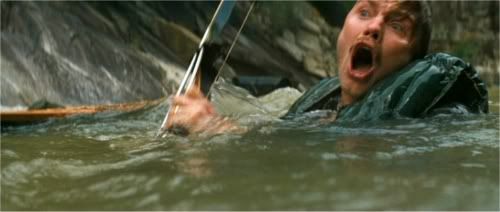
On the mythical Cahulawassee there is a deep gorge not far down stream from Resting Place. The four suburbanites bury McKinney and head back out on the water with no idea what lies up ahead. The sound of the gorge is rising in their ears when Drew, in the lead canoe, looks like he’s been hit by something. Without any warning he tumbles over the side. Now they are all caught up in a rush of white water too powerful for any of them to handle. One of the canoes is broken in half. The other tumbles through the falls. By the time they reach still water at the bottom of the gorge, Lewis’s leg is horribly broken. Drew has disappeared. And Bobby and Ed think he was shot. The other mountain man must be up there on the cliffs above them, waiting, they think.

It’s up to Ed, now, to save their lives, and the only way he can do that is to climb the side of the gorge at night. He puts his bow over his back with the razor-sharp arrows in a quiver attached to the handle and starts the long ascent through the dark.
The actual Chattooga didn’t have a suitable location for this action. But Talullah Falls, not far away, was perfect. There was a hydroelectric dam about a half mile upstream with gates that could adjust the ferocity of the torrent pouring through the gorge to suit the needs of the shot. The flow could be reduced to a trickle if need be. But it was still a dangerous place. The first half of the falls ended in a deep pool that you could swim or paddle across easily when the current was turned down. But the only way to walk to the other side of the gorge was on a slick, slightly submerged retaining wall twelve inches wide with the pool on one side and a ninety-foot drop on the other. Everyone used the wall, holding on to a little rope for security. I still don’t know why no one slipped when the water was low, or was washed over the precipice during filming when the river swelled across it in heavy. Maybe it was the luck of people who’d started to quit caring.Burt used to be a stunt man and wanted to take his own risks, do his own “gags.” And Boorman let him.

For the break-up of the canoes, special effects man Marcel Vercoutere devised a catapult to launch Reynolds thirty feet in the air, hurling him toward the pool. He was well padded, but he was still pretty badly beaten up on the rocks. Jon Voight took to climbing the lower levels of the cliff, sometimes fifty feet or more, without any safety equipment. Boorman let him. Jon was about twenty feet above the crew when he lost his hold and tumbled back off the rocks. A prop man was able to break his fall, barely, but stood frozen for a few seconds before he let Voight go. Everybody was frozen. The exposed blade of a hunting arrow on Jon’s bow quiver was a breath away from the prop man’s throat.
It was like the whole film was becoming some kind of macho gamble in which each man was out to prove he could take the risks the characters were running, characters that James Dickey had only imagined.

At the top of the gorge, 150 to 250 feet above the rocks, the risks were even greater, and everybody played. As they searched for the best camera angles, Boorman and Szigmond leaned way out over the edge of the precipice, and only rarely put on safety harnesses. Lives were risked to position lights, or to saw off a twig that blocked the lens.
In the story, Ed reaches the top of the cliff just before dawn. He sees the mountain man, rifle in hand, peering at the river below. Ed draws down on him. His hand starts to shake, just as it did with the deer. The mountain man sees him. Ed’s only going to get this one shot. The mountain man fires, and you’re not sure for several seconds if the arrow has hit him or not. Then the mountain man turns. You see the arrow in his chest and he falls to the ground. But Ed doesn’t leave him there. All this killing, all these crimes have to be buried by the river. He uses a rope to lower the mountain man’s body down the cliff and sink it in the pool.

The special effects men thought they’d use a dummy for the scene of a corpse dangling and twisting at the end of a cord high on the side of the cliff. But the dummy looked too much like a dummy. “Would Cowboy do it himself?” someone asked as the mannequin was dragged back up over the ledge. Cowboy took a look at the drop. It was about 200 feet at this point. He fingered the thin rope that would hold him. He shook his head. He took a swig of the Pabst Blue Ribbon beer he always had close at hand, and sighed, and nodded toward the dummy. “Well,” he said, “I g-guess if he c-can do it, so c-can I.”

Members of the crew and the artificial family at Kingwood began to go home. An assistant producer, both assistant directors, a camera operator and two nurses left for reasons of health, or weariness or frustration. Burt’s Numero Uno left, too, during the most dangerous part of the filming. But it was so important to him to be seen with a woman, even if no woman was at hand, that one day he came to the set in Tallulah gorge with a handful of love-letters written to him by women who’d slept with him. He passed them around to the crew for their reading enjoyment. One collection was from a pair of girls who called themselves Franny and Zooey. Another more depressing set of letters was from an exotic dancer in a Newport News service club who was trying to launch her son's career as a musician by having him play backup during her routines. Burt was going to be her ticket out of all that, she thought.
The filming moved back to the Chattooga for a last sequence on the roughest section of the river before the four surburbanites arrive on the still waters of the lake that is rising behind the fictional town of Aintry. One morning everybody arrived on the set to word that someone had been shooting at the trucks the night before. No one was hurt. Everyone was a little spooked. It added to the sense that the whole production was racing against time, against some impending disaster. But we were on the home stretch, and almost too tired to care.

A lot of times when the shooting was on the river the stand-ins were left waiting at pickup points to meet the actors and camera crew when they came in off the water. We’d been most of the day at one of the roughest sections of the Chattooga when a heavyset kid everyone called Chicago borrowed a raft from the prop department and suggested we try shooting the rapids. It was mid-summer now, and the only place you could see that was cool was in the water. We watched a couple of other members of the crew bounce downstream in inner tubes. They dropped over a ledge of about ten feet, twirling around for just a second in a whirlpool, then bouncing out and heading on down the river. It looked like a safe enough thrill.
Chicago and I got into the raft and kicked out from shore. We hit the current and started to twirl slowly, picking up speed as we approached the drop. Now we were over the edge. And down. And the raft filled with water and we started to spin. It wasn’t sinking, but it wasn’t moving out of the whirlpool either. It was agitating and banging like a tennis shoe in a washing machine. One of the boys on shore threw us a rope, and Chicago grabbed it and went over the side. I saw him resurface down river and get pulled by in by the others like some enormous salmon. I was gulping water under the falls, and the raft was spinning and shaking too fast for me to think of anything now except how I was going to get out of it. I knew I couldn’t make it swimming. I knew the hydraulic tumbler would drag me down to the bottom. I had to have the rope. The boys on shore were shouting and signaling. They were going to throw me the line, but I was supposed to tie it to the raft so they could pull it out. They threw. After a couple of tries, I caught. They left the line slack. But as the raft spun the rope wrapped around my chest, my arms, my neck. I struggled to get it off, tried to find some place to tie it, it looped over my head and neck again. The water pounded from above, boiled up from below. The raft felt like it was going to tear apart. I freed my neck of the rope again and wrapped the end around my hand and went over the side. The current pushed me straight to the bottom, banging my body on the rocks, twirling me at the end of the cord that tightened like a noose around my hand and wrist. And then I was back on the surface, and being pulled in to shore. I guess I looked like hell; as gray as the rocks by the riverside. “We thought we’d lost you,” said Chicago. “Me, too,” I said.

It was about as close as I’d ever come to dying, at least at that point in my life, and that evening I tried to tell my father all about it. But he seemed to have other things on his mind. He was back on the scene. Back in the movie.The shooting was almost over and he’d been given a part to play on screen. He was going to be Sheriff Bullard, who doesn’t really believe the story these city fellas tell him about what happened on the river -- “How come you boys to have four life jackets?” – but who lets them go anyway. My father had never acted before. Not as such. And it embarrassed me, then, to watch him on the set. When I watch the movie now and see those scenes I think he was just about perfect: he is big and menacing, and there is a little of the Winslow sheriff in him; but there is also this genteel insecurity as Bullard tries to cope with the hinted atrocities taking place in his county, and there are several times in his brief appearance when he is just so much like my father, even the best of my father, sober and thoughtful and picking his words with real care, that I am glad just to be able to see him. We were into the last days on the set there was a last scene to shoot in which my father and I appear together, although it was later cut from the movie. Ed and Bobby and Lewis are called back up from Atlanta to the dam at Aintry. Lewis is on crutches. All of them are wearing business clothes, all have come to see a corpse on a stretcher covered by a sheet. Sheriff Bullard reaches down and lifts the shroud to show them the body of – you’re not sure. It could be one of the mountain men. It could be Drew. You don’t know and you never do see. Ed wakes from the dream.
I was the corpse under the sheet...

All text and photos (c) Christopher Dickey